
 Nextier
By Kenneth Maduagwu
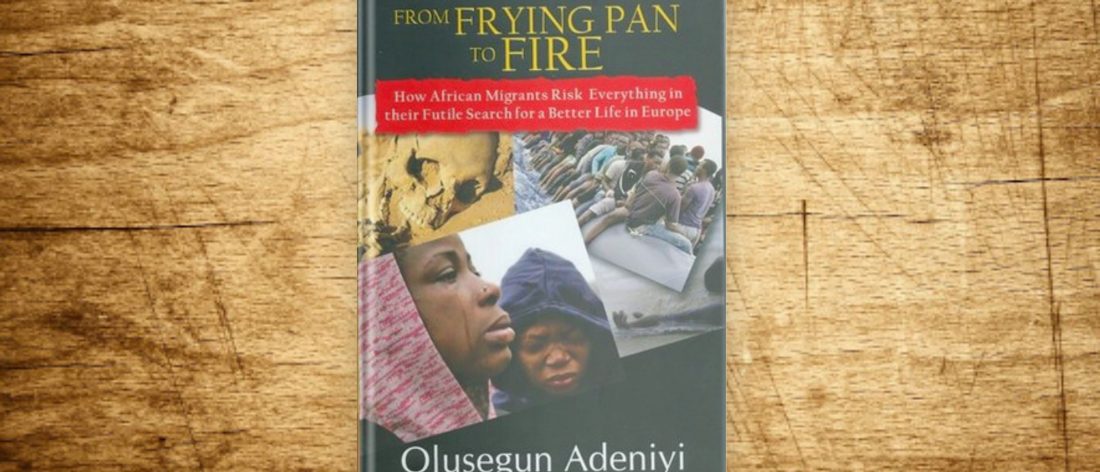
REVIEW: From Frying Pan to Fire, by Olusegun Adeniyi. Bookcraft Limited (October 2019) Length:182 pages.
The International Organization for Migration (IOM) in 2019, reported that Nigerian migrants account for the highest number of arrivals in Italy by the sea, with 17,000 migrants to the total African migrants of 99,127. An average Nigerian will not be amazed by this report, given the almost collective zeal or ‘ginger’ (in our local parlance), among young people to thrive and to succeed. Illegal migration has been a reality for decades. While one cannot help but blame the wave on the low services, unemployment, insecurity and all forms of bad governance, it is not rewarding to take the risk of migrating illegally.
Olusegun Adeniyi, a renowned writer, challenged by his brother’s story of trying to travel to Europe on three failed occasions through the Sahara Desert and the Mediterranean sought to discourage illegal migration through the startling revelations of his brother, Agboola. Agboola narrated his experience in the hands of Tuareg warriors along Assamakka, en route Libya. According to him “on our way, we came to a checkpoint where soldiers warned us to change our route because Tuareg warriors were along the way. Unknown to us, the men at the checkpoint were themselves, Tuareg warriors and not soldiers”. They were tricked and robbed of all their belongings, and a trigger-happy young boy among them shot dead three of the migrants who tried to escape.”
Besides Agboola’s ordeal, the author showed an uncommon commitment towards championing the fight against illegal migration by gathering the relevant information that makes a fantastic case against unlawful migration and discloses the modus operandi of the criminal networks, routes and fatalities – generously achieved by depth, collaboration and accounts.
Another victim, Kate, lost her father and her mother remarried, leaving her to her grandmother. Her grandmother conspired with her stepdaughter to hand Kate over to a ‘madam’. Before the trip, she was taken to a juju priest where she was forced to drink some concoction as an oath to pay €35,000 to the ‘madam’ in return for taking her to Europe.
The story is the same in other African countries like Ghana, Guinea and Liberia. In October 2016, UNICEF reported the drowning of 3 Liberian Nationals while crossing the Mediterranean to Italy. A survivor said that she paid $2,400 for her family to make the trip to Italy. The boat capsized, and her children and brother died in the incident.
Undocumented and illegal migrants are controlled, by a massive criminal network that has within its fold transporters, security men, clergy, hoteliers and juju priests who work by luring poor girls away from the villages with promises of a better life, sell them into slavery. Sordid tales of extortion, slavery, rape, forced prostitution, drugs, arrests and deaths characterize the voyages from Lagos or Kano, Niger or Mali into the Sahara Desert, which has for years been the main transit port for migrants seeking to access Europe by Sea.
Olusegun Adeniyi recounts that the notoriety of trafficking in Edo started during the military regime in the eighties when the Nigerian economy was beginning to tank, there were opportunities in Italy’s booming agriculture sector, especially in tomato picking. During the economic meltdown, the hunger to travel abroad to seek greener pastures grew. Some women who made it to Italy found it challenging to meet their needs, which prompted the selling of their bodies to earn a living. Unfortunately, they realized that sex trade benefited them much more than the business of picking tomatoes.
Notwithstanding the heightened figures of fatalities, Nigeria and other countries have continued to experience the swelling of illegal migration on the premise of searching for a better life. Interesting, this piece has shown that it is a misconception that leads migrants straight to fire. The International Organisation for Migration from the 19th round of data collection conducted in 2018 revealed that no fewer than 690,351 migrants are still in Libya.
Following the depth of analysis and data made available, this book is an essential tool for government officials to guide them on migration and boundary policies. Also, the various non-profits, civil society and development agencies concerned about human trafficking and migration will find this piece insightful.